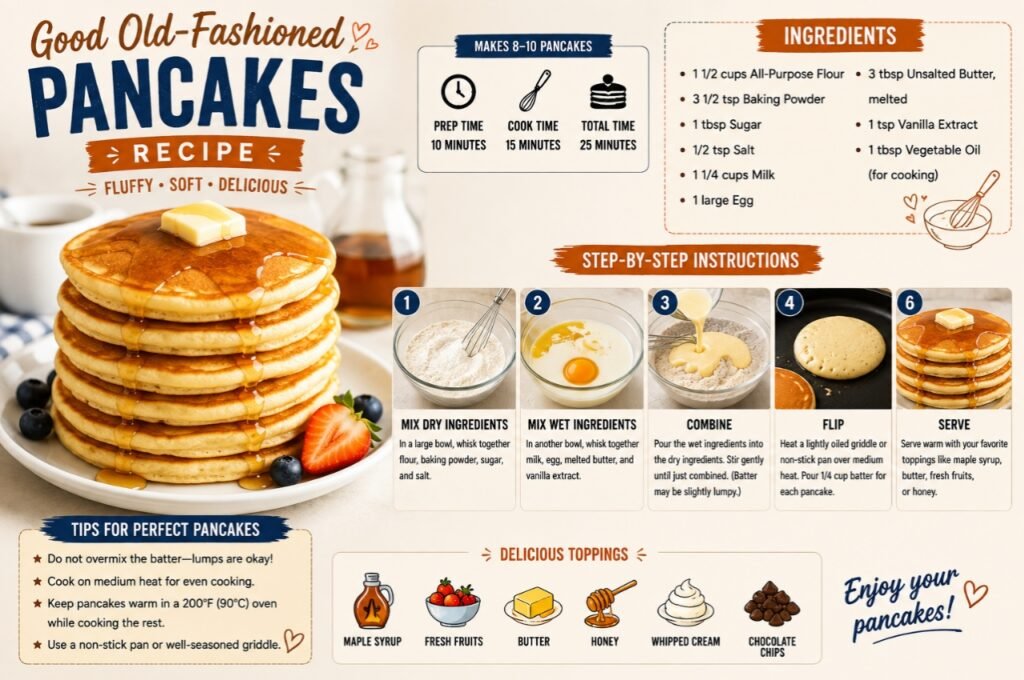

Good Old-Fashioned Pancakes are one of those timeless breakfast recipes that never go out of style. They are simple, fluffy, lightly sweet, golden around the edges, and incredibly comforting. Made with everyday pantry ingredients, these homemade pancakes are perfect for a relaxed weekend breakfast, a family brunch, or whenever you want something warm and satisfying.
If you are looking for an easy Good Old-Fashioned Pancakes recipe, this guide gives you everything you need to make a delicious stack from scratch. From choosing the right ingredients to mixing the batter, cooking the pancakes, storing leftovers, and serving them with your favorite toppings, every important detail is covered.
What Are Good Old-Fashioned Pancakes?
Good Old-Fashioned Pancakes are classic American-style pancakes made from a straightforward batter of flour, milk, eggs, butter, sugar, baking powder, and salt. The batter is cooked on a lightly greased skillet or griddle until the pancakes become golden brown and fluffy.
Unlike complicated modern pancake recipes, Good Old-Fashioned Pancakes focus on simple ingredients and traditional preparation. Their appeal comes from their soft texture, buttery flavor, and versatility.
These pancakes can be served with maple syrup, fresh berries, sliced bananas, whipped cream, powdered sugar, butter, honey, or almost any topping you enjoy.
Why You Will Love This Good Old-Fashioned Pancakes Recipe
There are plenty of reasons to keep a classic pancake recipe in your regular breakfast rotation.
First, the ingredients are inexpensive and easy to find. You probably already have most of them in your kitchen.
Second, the recipe is simple enough for beginners. You do not need special equipment or advanced cooking skills.
Third, the pancakes can be customized in countless ways. You can add blueberries, chocolate chips, cinnamon, bananas, nuts, or other ingredients to create different flavors.
Most importantly, homemade Good Old-Fashioned Pancakes taste much better than many packaged alternatives. Freshly cooked pancakes have a soft center, lightly crisp edges, and a warm buttery aroma that makes breakfast feel special.
Good Old-Fashioned Pancakes Ingredients
The ingredient list is short, but each ingredient has an important job.
| Ingredient | Approximate Amount | Purpose |
|---|---|---|
| All-purpose flour | 1½ cups | Provides structure |
| Baking powder | 3½ teaspoons | Helps pancakes rise |
| Salt | ¼ teaspoon | Balances flavor |
| Granulated sugar | 1 tablespoon | Adds gentle sweetness |
| Milk | 1¼ cups | Creates the batter |
| Egg | 1 large | Adds structure and richness |
| Melted butter | 3 tablespoons | Adds flavor and tenderness |
| Butter or oil | As needed | Greases the pan |
| Maple syrup | For serving | Adds sweetness |
The exact quantities can be adjusted slightly depending on the desired batter consistency and the size of the pancakes you want to make.
How to Make Good Old-Fashioned Pancakes
Making Good Old-Fashioned Pancakes from scratch is easier than it may seem. The key is to avoid overmixing the batter and to cook the pancakes over moderate heat.
Step 1: Prepare the Dry Ingredients
Start by adding the flour, baking powder, salt, and sugar to a large mixing bowl.
Whisk the dry ingredients together until they are evenly combined. This step helps distribute the baking powder and salt throughout the flour.
Even distribution is important because you want every pancake to rise evenly.
Step 2: Combine the Wet Ingredients
In a separate bowl, whisk together the milk, egg, and melted butter.
Make sure the melted butter has cooled slightly before adding it to the egg and milk. Very hot butter can affect the egg.
Whisk the wet ingredients until the mixture looks smooth and uniform.
Step 3: Make the Pancake Batter
Pour the wet mixture into the bowl containing the dry ingredients.
Gently stir everything together with a whisk or spatula.
Do not try to make the batter completely smooth. A few small lumps are perfectly fine.
Overmixing can develop too much gluten in the flour, which may result in dense or chewy pancakes instead of light and fluffy ones.
Step 4: Rest the Batter
Allow the batter to rest for a few minutes before cooking.
This short resting period gives the flour time to absorb some of the liquid and allows the ingredients to settle.
The batter should be thick enough to pour slowly but fluid enough to spread naturally on the cooking surface.
Step 5: Heat the Skillet
Place a nonstick skillet, cast-iron pan, or griddle over medium heat.
Allow the pan to become properly heated before adding the batter.
A pan that is too cool can produce pale, flat pancakes, while a pan that is too hot may burn the outside before the inside is cooked.
Lightly grease the surface with butter or a small amount of neutral cooking oil.
Step 6: Cook the Pancakes
Pour approximately ¼ cup of batter onto the heated pan for each pancake.
Depending on the size of your skillet, you can cook several pancakes at once.
Let each pancake cook until bubbles begin appearing on the surface and the edges look slightly set.
This usually takes a couple of minutes, but cooking time can vary depending on the heat and pancake size.
Step 7: Flip Carefully
When bubbles form across the surface and some of them begin to pop, slide a spatula underneath the pancake.
Flip it gently but confidently.
Cook the second side until it becomes golden brown and the center is fully cooked.
Avoid repeatedly flipping the pancake because excessive handling can affect its texture.
Step 8: Serve Warm
Transfer the cooked pancakes to a plate.
Continue cooking the remaining batter.
For the best experience, serve Good Old-Fashioned Pancakes warm with butter and maple syrup.
You can also add fresh fruit, whipped cream, powdered sugar, honey, jam, or other toppings.
The Secret to Fluffy Good Old-Fashioned Pancakes
The most important secret to fluffy pancakes is simple: do not overmix the batter.
When flour is mixed with liquid, gluten begins developing. A small amount of gluten is useful because it gives pancakes structure, but too much can make them tough.
Mix only until the ingredients are combined.
Another important factor is fresh baking powder. Baking powder loses strength over time, and old baking powder may not provide enough lift.
Proper pan temperature also matters. Medium heat generally provides enough time for the inside of the pancake to cook while allowing the exterior to develop a beautiful golden color.
How Thick Should Pancake Batter Be?
Good Old-Fashioned Pancakes batter should have a moderately thick consistency.
It should pour easily from a spoon or measuring cup but should not look watery.
If your batter is too thick, add a small amount of milk.
If it is too thin, add a little flour.
Make adjustments gradually because adding too much flour or milk at once can change the texture significantly.
Common Mistakes When Making Good Old-Fashioned Pancakes
Even a simple pancake recipe can go wrong if a few basic details are overlooked.
Overmixing the Batter
One of the most common mistakes is mixing until the batter is perfectly smooth.
A few lumps are desirable.
Mixing too much can create pancakes that are dense and rubbery.
Using Excessive Heat
High heat may seem like a shortcut, but it often causes uneven cooking.
The outside can become dark while the inside remains undercooked.
Medium or medium-low heat usually works better.
Pressing the Pancakes
Do not press down on the pancakes with your spatula after flipping.
Pressing removes air from the pancake and can make the finished result flatter and denser.
Flipping Too Early
If you flip the pancake before bubbles appear and the edges begin to set, the batter may spread or tear.
Wait for visible signs that the first side is ready.
Flipping Too Often
A pancake generally needs only one flip.
Repeated flipping can interfere with even cooking and may make the pancakes less tender.
How to Tell When Pancakes Are Ready to Flip
Knowing when to flip is one of the most useful pancake-making skills.
Look for several signs at the same time.
The surface should begin developing bubbles.
Some bubbles should pop and leave small holes.
The edges should look slightly dry or set.
The bottom should have developed a golden-brown color.
Once these signs appear, carefully flip the pancake.
Best Pan for Good Old-Fashioned Pancakes
A nonstick skillet is one of the easiest choices for beginners because pancakes are less likely to stick.
A well-seasoned cast-iron skillet can also produce excellent results and provides steady heat.
A flat griddle is especially convenient when preparing pancakes for a larger family because it provides more cooking space.
Whatever pan you choose, maintaining a consistent temperature is more important than the material itself.
Butter or Oil for Cooking Pancakes?
Both butter and oil can be used.
Butter gives pancakes a delicious rich flavor and helps create lightly browned edges.
However, butter can burn if the pan becomes too hot.
Neutral cooking oil has a higher smoke point and can make temperature control easier.
You can also use a small combination of butter and oil for flavor and cooking stability.
How to Keep Pancakes Warm
If you are preparing a large batch of Good Old-Fashioned Pancakes, you may want to keep the finished pancakes warm while the rest cook.
Place the cooked pancakes on a heat-safe plate or baking sheet and keep them in a warm oven.
Avoid using excessive heat because pancakes can dry out.
Another simple option is to loosely cover the pancakes with foil for a short period.
Do not stack extremely hot pancakes for a long time if you want to preserve their crisp edges.
Good Old-Fashioned Pancakes Topping Ideas
Classic pancakes are delicious with simple toppings, but there are countless ways to customize them.
| Topping | Flavor Profile |
|---|---|
| Maple syrup | Classic and sweet |
| Fresh strawberries | Fruity and refreshing |
| Blueberries | Juicy and slightly tart |
| Banana slices | Naturally sweet |
| Whipped cream | Light and creamy |
| Powdered sugar | Delicate sweetness |
| Honey | Floral and rich |
| Peanut butter | Nutty and creamy |
| Chocolate chips | Rich and indulgent |
| Jam | Fruity and concentrated |
| Chopped pecans | Crunchy and nutty |
| Cinnamon sugar | Warm and aromatic |
For a classic breakfast, butter and maple syrup are hard to beat.
For a more indulgent option, add whipped cream, berries, and chocolate chips.
How to Make Blueberry Good Old-Fashioned Pancakes
Blueberries are an easy addition to the basic recipe.
You can gently fold fresh or frozen blueberries into the batter.
Another method is to sprinkle blueberries onto the pancakes after pouring the batter into the skillet.
This can help distribute the berries more evenly.
If using frozen blueberries, there is generally no need to thaw them first. Thawing can release additional liquid and may cause the batter to become streaked.
How to Make Chocolate Chip Pancakes
Chocolate chips can turn classic Good Old-Fashioned Pancakes into a dessert-like breakfast.
Add a modest amount of chocolate chips to the batter or sprinkle them over each pancake after the batter is placed in the pan.
Use medium heat because chocolate can scorch when exposed to excessive heat.
Serve chocolate chip pancakes with sliced bananas, powdered sugar, or a small amount of maple syrup.
How to Make Banana Pancakes
Mashed ripe banana can add natural sweetness and moisture to pancake batter.
For a stronger banana flavor, use a very ripe banana.
Because banana adds moisture, you may need a small adjustment to the amount of liquid or flour depending on the size of the banana.
Banana pancakes pair especially well with cinnamon, walnuts, honey, and maple syrup.
Cinnamon Good Old-Fashioned Pancakes
Cinnamon is an easy way to add warmth to a classic pancake recipe.
Add a small amount of ground cinnamon to the dry ingredients.
For additional flavor, serve the finished pancakes with sliced apples, bananas, honey, or a dusting of cinnamon sugar.
The result is comforting and especially suitable for fall and winter breakfasts.
Can You Make Good Old-Fashioned Pancakes Ahead of Time?
Yes, pancakes can be prepared ahead of time.
Cook the pancakes as usual and allow them to cool completely.
Place parchment paper between individual pancakes or small groups of pancakes to prevent excessive sticking.
Store them in an airtight container in the refrigerator for short-term storage.
For longer storage, freeze them.
How to Freeze Good Old-Fashioned Pancakes
Freezing pancakes is a convenient way to prepare breakfast in advance.
Allow the cooked pancakes to cool completely.
Place parchment or wax paper between pancakes so they can be separated easily.
Transfer them to a freezer-safe bag or airtight container.
Remove as much excess air as practical before sealing.
Label the container with the date.
When you want pancakes, reheat only the amount you need.
How to Reheat Pancakes
There are several convenient reheating methods.
Microwave
Place one or two pancakes on a microwave-safe plate.
Heat them for a short period and check the texture.
Avoid overheating because pancakes can become chewy or dry.
Oven
Place pancakes on a baking sheet and warm them in a low-temperature oven.
This method works particularly well when reheating a larger batch.
Toaster
A toaster can provide lightly crisp edges and is convenient for individual pancakes.
However, make sure the pancakes are not too thick for your appliance.
How to Store Leftover Pancakes
Allow leftover pancakes to cool before placing them in the refrigerator.
Store them in an airtight container.
Refrigerated pancakes are best enjoyed within a few days for the best quality.
If you know you will not eat them soon, freezing is usually a better option.
Good Old-Fashioned Pancakes for a Family Breakfast
Classic pancakes are ideal for family breakfasts because the recipe can easily be scaled.
You can prepare a large bowl of batter and cook pancakes in batches.
Set up a topping station with maple syrup, berries, sliced bananas, whipped cream, butter, and powdered sugar.
This allows everyone to build their own breakfast.
For children, small pancakes are often easier to handle and can be served with fruit.
How to Make Smaller Pancakes
If you want mini pancakes, reduce the amount of batter used for each pancake.
A tablespoon or two of batter can produce small, bite-sized pancakes.
Mini pancakes are excellent for brunch buffets, children’s breakfasts, or party-style serving.
Because they cook quickly, watch them carefully to prevent overbrowning.
How to Make Larger Pancakes
For larger pancakes, use a bigger portion of batter.
However, extremely large pancakes can be difficult to flip.
If you are still learning how to make pancakes, medium-sized pancakes are usually easier to manage.
They also cook more evenly.
Can You Make Good Old-Fashioned Pancakes Without Butter?
Yes.
You can replace melted butter in the batter with a neutral cooking oil.
The flavor will be slightly different, but the pancakes can still be soft and delicious.
You can also grease the pan with oil instead of butter.
If you enjoy buttery flavor, serve the finished pancakes with a small pat of butter.
Can You Make Pancakes Without Milk?
Yes, depending on your dietary needs and available ingredients.
Milk can be replaced with several alternatives, including plant-based beverages.
Unsweetened options are generally easiest to control because they do not add unnecessary sweetness.
Keep in mind that different milk alternatives can produce slightly different textures and flavors.
Can You Make Good Old-Fashioned Pancakes Without Eggs?
Eggs contribute structure, richness, and tenderness to pancakes.
If you need an egg-free version, there are several possible substitutes.
Mashed banana, applesauce, commercial egg replacers, or other suitable substitutes can sometimes work.
However, each substitution changes the texture, so the final result may differ from traditional Good Old-Fashioned Pancakes.
How to Make Pancakes More Fluffy
To make fluffy pancakes, focus on a few fundamentals.
Use fresh leavening ingredients.
Do not overmix the batter.
Use the correct amount of liquid.
Allow the batter to rest briefly.
Cook over moderate heat.
Flip only once when the surface shows clear signs that the pancake is ready.
These simple habits can make a noticeable difference.
How to Make Pancakes Crispy Around the Edges
If you enjoy pancakes with slightly crisp edges, use a properly preheated pan and a small amount of butter or oil.
The cooking fat should coat the surface lightly.
Avoid using so much fat that the pancakes become greasy.
A moderately hot pan can help create golden edges while keeping the center soft.
How to Make Pancakes Soft and Tender
Soft pancakes begin with properly mixed batter.
Do not overwork the flour.
Use enough liquid to create a thick but pourable batter.
Avoid pressing down on the pancakes during cooking.
Remove the pancakes from the heat as soon as they are fully cooked.
Overcooking can cause moisture loss and produce dry pancakes.
Serving Suggestions for Good Old-Fashioned Pancakes
A classic stack of pancakes can be served in many different ways.
For a traditional breakfast, serve warm pancakes with butter and maple syrup.
For a fruity breakfast, add strawberries, blueberries, raspberries, or banana slices.
For an indulgent breakfast, add whipped cream and chocolate chips.
For a nutty version, sprinkle chopped walnuts or pecans over the top.
For a simple presentation, finish with powdered sugar.
Good Old-Fashioned Pancakes for Brunch
Pancakes are an excellent brunch centerpiece.
Prepare several batches and arrange them on a serving platter.
Offer different toppings so guests can customize their plates.
You can also serve pancakes alongside scrambled eggs, fresh fruit, yogurt, breakfast potatoes, or other brunch favorites.
For a crowd, keeping the pancakes warm in a low oven makes serving easier.
Nutritional Considerations
The nutritional value of pancakes depends on the ingredients, serving size, and toppings.
Plain pancakes contain carbohydrates from flour and sugar, protein from eggs and milk, and fat from butter and other ingredients.
Adding syrup, whipped cream, chocolate, or large amounts of butter increases the overall calorie and sugar content.
For a lighter serving, use fresh fruit and a moderate amount of syrup.
Remember that nutritional needs vary from person to person.
Tips for the Best Good Old-Fashioned Pancakes
Use fresh baking powder.
Measure flour accurately.
Do not pack flour tightly into a measuring cup if using volume measurements.
Whisk dry ingredients before adding wet ingredients.
Mix the batter gently.
Do not worry about small lumps.
Preheat the pan properly.
Use moderate heat.
Wait for bubbles before flipping.
Flip the pancake only once when possible.
Serve the pancakes warm.
These small details can transform an ordinary batch into excellent homemade pancakes.
Troubleshooting Good Old-Fashioned Pancakes
| Problem | Possible Cause | Solution |
|---|---|---|
| Pancakes are flat | Old baking powder or overmixed batter | Use fresh leavening and mix gently |
| Pancakes are burnt | Heat is too high | Reduce the temperature |
| Pancakes are raw inside | Pancakes are too thick or heat is too high | Use moderate heat and smaller portions |
| Pancakes are tough | Batter was overmixed | Stir only until combined |
| Pancakes stick | Pan is not properly greased or heated | Lightly grease and preheat |
| Pancakes are pale | Pan is too cool | Allow the pan to heat longer |
| Pancakes are dry | Overcooking or too little liquid | Cook until just done |
| Batter is too thick | Not enough liquid | Add milk gradually |
| Batter is too thin | Too much liquid | Add a small amount of flour |
Good Old-Fashioned Pancakes Recipe at a Glance
| Category | Details |
|---|---|
| Recipe type | Breakfast |
| Cuisine | American-inspired |
| Main ingredient | All-purpose flour |
| Texture | Soft and fluffy |
| Flavor | Buttery, lightly sweet |
| Cooking method | Skillet or griddle |
| Difficulty | Easy |
| Best served | Warm |
| Suitable for | Breakfast and brunch |
| Popular toppings | Butter, maple syrup, fruit |
| Preparation | Quick and simple |
| Skill level | Beginner-friendly |
Why Homemade Pancakes Are Worth Making
There is something special about making pancakes from scratch.
The process is simple enough to fit into a normal morning, yet the result feels much more special than an ordinary breakfast.
You control the ingredients, sweetness, thickness, and toppings.
Fresh pancakes also allow you to customize every serving according to personal preferences.
Whether you are cooking for yourself, your family, or weekend guests, Good Old-Fashioned Pancakes are an easy recipe that can bring everyone to the breakfast table.
Final Thoughts on Good Old-Fashioned Pancakes
Good Old-Fashioned Pancakes prove that great food does not need complicated ingredients or elaborate techniques. A few basic pantry staples, a properly mixed batter, and a well-heated skillet are enough to create a warm and satisfying breakfast.
The most important things to remember are simple: use fresh baking powder, measure your ingredients carefully, avoid overmixing, cook over moderate heat, and wait for the right signs before flipping.
Once you understand these basics, you can confidently make classic pancakes and experiment with your own variations.
Serve your Good Old-Fashioned Pancakes with butter and maple syrup for a traditional breakfast, or customize them with berries, bananas, chocolate chips, nuts, cinnamon, whipped cream, or other favorite toppings.
This classic recipe is easy, adaptable, family-friendly, and suitable for everything from an ordinary weekday breakfast to a relaxed weekend brunch.
What are Good Old-Fashioned Pancakes?
Good Old-Fashioned Pancakes are classic homemade pancakes made with simple ingredients such as flour, milk, eggs, baking powder, butter, sugar, and salt. They are known for their soft, fluffy centers and golden-brown edges.
How do I make Good Old-Fashioned Pancakes fluffy?
For fluffy Good Old-Fashioned Pancakes, avoid overmixing the batter, use fresh baking powder, and cook the pancakes over medium heat. Small lumps in the batter are completely fine.
Should pancake batter be completely smooth?
No. Pancake batter does not need to be perfectly smooth. A few small lumps are normal and often produce better-textured pancakes because overmixing can make them tough.
What is the best temperature for cooking pancakes?
Medium heat is usually ideal for Good Old-Fashioned Pancakes. If the outside becomes dark before the center cooks, lower the heat. If the pancakes remain pale for too long, slightly increase it.
Can I prepare Good Old-Fashioned Pancakes ahead of time?
Yes. Let the pancakes cool completely, separate them with parchment paper, and place them in a freezer-safe bag or airtight container. Reheat only the amount you need.
Can I add blueberries to the pancake batter?
Yes. Fresh or frozen blueberries can be added to Good Old-Fashioned Pancakes. You can fold them gently into the batter or sprinkle them over each pancake after pouring the batter into the skillet.
What is the easiest way to reheat pancakes?
Pancakes can be reheated in a microwave, oven, or toaster. The microwave is convenient for a small serving, while an oven works well when reheating several pancakes at once.
Why is the first pancake sometimes not perfect?
The first pancake often helps you determine whether the skillet is too hot or too cool. Once you adjust the temperature, the following pancakes usually cook more evenly.
What should I serve with Good Old-Fashioned Pancakes?
Good Old-Fashioned Pancakes pair well with fresh fruit, scrambled eggs, yogurt, breakfast potatoes, bacon, sausage, or other breakfast favorites.