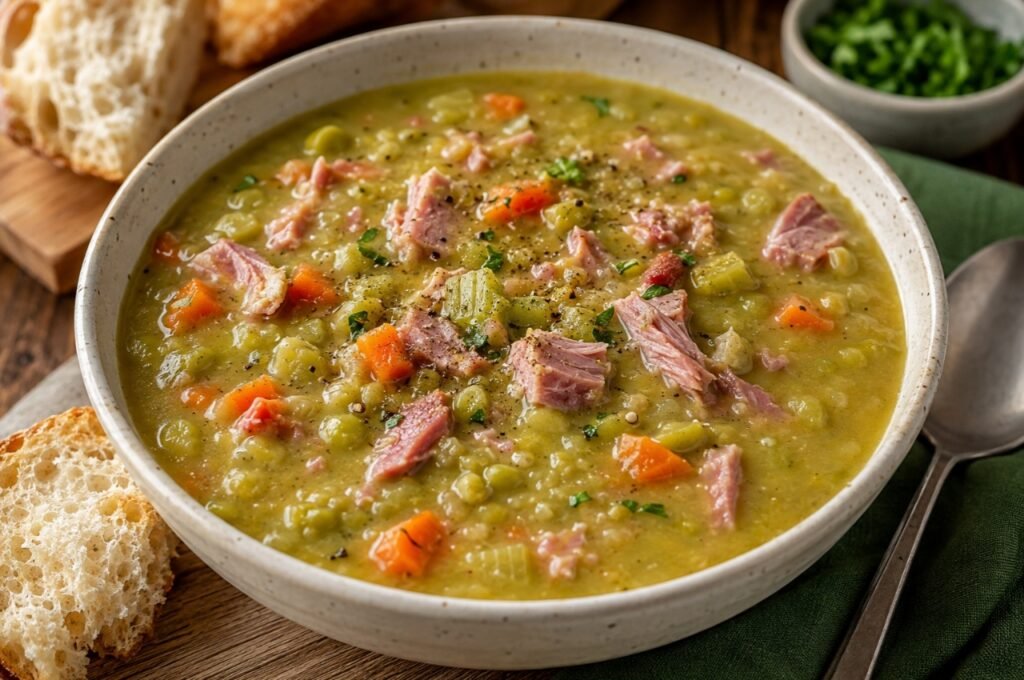

A comforting pea and ham soup recipe is one of those classic homemade meals that proves simple ingredients can create incredible flavor. Dried green split peas slowly cook with tender vegetables and savory ham, creating a thick, satisfying soup that is perfect for chilly evenings, relaxed family dinners, or a comforting weekend lunch. The natural starch from the split peas gives this soup a creamy texture without requiring heavy cream, while ham adds a rich, smoky and salty character that makes every spoonful delicious.
This version of pea and ham soup recipe is designed to be practical, flavorful and easy to prepare. You can make it with a meaty ham hock, a leftover ham bone, or cooked ham depending on what you have available. The basic cooking method is forgiving, which makes this an excellent recipe for beginners as well as experienced home cooks. Split peas gradually soften during cooking and help thicken the broth naturally, so there is no need for complicated techniques or expensive ingredients.
The recipe is inspired by the traditional style of pea and ham soup, including the use of dried split peas, ham, onion, carrot, celery, garlic and bay leaves. The reference recipe from RecipeTin Eats also uses a meaty ham hock and explains that split peas do not require the same soaking process as many dried beans.
What Is Pea and Ham Soup?
Pea and ham soup is a traditional comfort food made by cooking dried peas with ham and vegetables until the peas become soft and creamy. The ham bone or ham hock contributes deep savory flavor to the cooking liquid, while the peas naturally break down and create the soup’s signature thick consistency. Depending on personal preference, the finished soup can be left rustic and chunky or partially blended for a smoother texture.
Unlike fresh green pea soup, this dish usually relies on dried green split peas. Split peas are mature peas that have been dried and split into halves, allowing them to cook relatively quickly and soften into the soup. RecipeTin Eats notes that green split peas are earthy and neutral enough to absorb the flavor of the ham as they cook.
The combination is particularly satisfying because every ingredient has a purpose. Peas provide body and texture, ham delivers savory depth, carrots add subtle sweetness, celery contributes freshness, onion builds the aromatic base, and garlic and bay leaves add extra layers of flavor. The result is a hearty soup that can easily become a complete meal when served with crusty bread.
Why You Will Love This Pea and Ham Soup Recipe
There are many reasons this pea and ham soup recipe deserves a place in your regular cooking rotation. First, it uses affordable pantry staples and inexpensive vegetables. Second, a leftover ham bone can be transformed into an entirely new meal rather than being thrown away. Third, the soup can be prepared on the stovetop, in a slow cooker, or in a pressure cooker with suitable adjustments. Traditional versions also commonly use ham hocks or cured ham bones to develop a deeply flavored broth.
Another advantage is that the soup becomes more flavorful as the ham and peas cook together. You do not need a complicated stock if your ham bone is meaty and flavorful. The soup is also naturally thick because the split peas release starch during cooking. If you prefer a completely smooth texture, you can blend it, but a partially blended soup gives you a wonderful balance of creamy broth, vegetables and pieces of shredded ham.
Pea and Ham Soup Recipe at a Glance
| Category | Details |
|---|---|
| Recipe Name | Pea and Ham Soup Recipe |
| Cuisine | British-inspired / Western |
| Course | Main Course, Lunch, Dinner |
| Preparation Time | About 15 minutes |
| Cooking Time | About 2 to 3 hours on the stovetop |
| Slow Cooker Time | About 8 to 10 hours on low |
| Servings | 6 to 8 |
| Main Ingredient | Green split peas |
| Protein | Ham hock, ham bone or cooked ham |
| Texture | Thick, creamy and hearty |
| Difficulty | Easy |
| Best Served With | Crusty bread, toast or garlic bread |
Ingredients for Pea and Ham Soup Recipe
The ingredients for this pea and ham soup recipe are simple, but choosing good-quality ham makes a noticeable difference. For a traditional result, use a meaty ham hock or leftover ham bone. The bone contributes flavor while the meat becomes tender enough to shred into the soup.
| Ingredient | Suggested Amount | Purpose |
|---|---|---|
| Dried green split peas | 500 g / about 1 lb | Creates the thick soup base |
| Meaty ham hock or ham bone | 1.2–1.5 kg / about 2.5–3 lb | Adds smoky, savory flavor |
| Onion | 1 medium | Builds aromatic flavor |
| Carrots | 2 | Adds sweetness and color |
| Celery | 2 stalks | Adds freshness and savory depth |
| Garlic | 2 cloves | Adds aromatic flavor |
| Bay leaves | 2 | Adds herbal depth |
| Black pepper | About ¾ teaspoon | Adds gentle heat |
| Salt | To taste | Balances the soup |
| Water | About 2 liters / 8 cups | Cooking liquid |
| Fresh parsley | For garnish | Adds freshness |
| Crusty bread | For serving | Perfect accompaniment |
These proportions are based on the traditional combination of split peas, meaty ham, vegetables and water used in the reference style. RecipeTin Eats lists 500 g of split peas, a 1.2–1.5 kg ham hock, onion, carrot, celery, garlic, bay leaves and approximately 2 liters of water.
Choosing the Best Ham
The ham is the heart of this pea and ham soup recipe, so choose a piece with plenty of meat attached to the bone if possible. A ham hock is particularly useful because it contains bone, connective tissue and meat. As it cooks, the meat becomes tender and the cooking liquid gains a rich savory character.
A leftover ham bone from a holiday meal is another excellent choice. It is a practical way to reduce food waste while creating a completely different meal. Make sure the bone still has some meat attached because a completely bare bone will provide less shredded ham for serving.
You can also use smoked ham hocks if you enjoy a stronger smoky flavor. However, smoked or cured ham can be salty, so it is better to season the soup gradually rather than adding a large amount of salt at the beginning. RecipeTin Eats specifically recommends tasting and adjusting salt near the end because the ham can contribute substantial salt to the finished soup.
Do You Need to Soak Split Peas?
One of the most convenient features of this pea and ham soup recipe is that green split peas generally do not need overnight soaking. Split peas are already divided into smaller pieces, allowing them to soften during cooking. RecipeTin Eats notes that split peas can be used without the overnight soaking typically associated with many dried beans.
Before cooking, inspect the peas and remove any unwanted debris. If your peas are dusty or were purchased from an open bulk container, rinse them under cool running water and drain well. Packaged split peas are usually ready to use after checking them.
Soaking is not harmful if you prefer to do it, but it is unnecessary for the straightforward version of this recipe. If you soak the peas, they may cook somewhat faster, so keep an eye on the consistency while simmering.
How to Make Pea and Ham Soup Recipe
Step 1: Prepare the Ingredients
Start by preparing the vegetables. Peel and finely chop the onion and carrots, then chop the celery into small pieces. Mince the garlic. Pick through the split peas to make sure there are no unwanted particles, then rinse them if necessary.
Keeping the vegetables relatively small helps them cook evenly and makes the finished soup easier to eat. You do not need to make perfect restaurant-style cuts because the vegetables will become very tender during the long cooking process.
Step 2: Add the Split Peas
Place the rinsed split peas into a large heavy pot, Dutch oven or suitable slow cooker. Add the chopped onion, carrots, celery and garlic around the peas.
The peas will absorb liquid and expand as they cook, so use a pot that provides enough room for the ingredients and liquid. A large pot also makes it easier to remove the ham bone later.
Step 3: Add the Ham
Place the ham hock or meaty ham bone into the pot. The ham should sit comfortably among the vegetables and peas. If the ham is especially large, position it so that as much of the meat as possible is surrounded by the cooking liquid.
This is where the main flavor development begins. As the ham cooks, its savory juices move into the broth while the peas absorb that flavor.
Step 4: Add Water and Seasoning
Pour in approximately 2 liters of water, or enough to generously cover the ingredients. Add bay leaves and black pepper. Be conservative with salt at this stage because ham can already be quite salty.
The reference version uses water rather than requiring a separate stock, relying on the ham bone to provide much of the flavor. However, if your ham is mild or you want a stronger broth, you can replace part of the water with low-sodium chicken stock or vegetable stock.
Step 5: Bring the Soup to a Simmer
Bring the pot to a boil over medium-high heat. Once boiling, reduce the heat to low so the soup maintains a gentle simmer.
Avoid boiling the soup aggressively for the entire cooking period. A gentle simmer gives the peas enough time to soften and allows the ham to become tender without unnecessarily evaporating too much liquid.
Step 6: Cook Until the Peas Are Tender
Cover the pot partially and simmer until the split peas are very soft and the ham can be easily pulled away from the bone. Depending on the ham and cooking conditions, this can take roughly 2 to 3 hours on the stovetop.
Traditional pea and ham soup recipes commonly rely on slow cooking to soften the peas and tenderize the ham. Great British Chefs, for example, uses a long simmer to fully cook green split peas and create a thick soup.
Stir the soup occasionally, particularly toward the end of cooking, because thick split pea soup can settle on the bottom of the pot. If the soup becomes too thick before the ham is tender, add a little hot water.
Step 7: Remove the Ham Bone
Once the ham is tender, carefully transfer the ham hock or bone to a large plate or bowl. Allow it to cool enough to handle safely.
Remove the meat from the bone and shred or chop it into bite-sized pieces. Discard the bone, skin, excess fat and any tough connective tissue.
The amount of usable meat will vary depending on the ham hock. Keep the tender meat and return it to the soup later.
Step 8: Remove the Bay Leaves
Remove the bay leaves before blending or serving. Bay leaves are used to flavor the soup but should not be eaten.
This is also a good time to check the overall texture. The peas should be soft enough that they naturally thicken the broth.
Step 9: Blend the Soup
For a rustic pea and ham soup recipe, you can leave the soup mostly chunky. For a creamier texture, use an immersion blender and blend several times.
Partial blending is often ideal because it thickens the broth without completely removing the texture of the vegetables. RecipeTin Eats recommends briefly blending the soup rather than necessarily making it completely smooth.
If you want a completely smooth soup, blend more thoroughly. If using a countertop blender, work carefully with hot liquid and avoid overfilling the blender.
Step 10: Return the Ham
Add the shredded ham back into the soup and stir well. Taste carefully before adding additional salt.
If the soup is too thick, stir in hot water or low-sodium stock a little at a time. If it is too thin, simmer uncovered for several additional minutes to allow excess liquid to evaporate.
Step 11: Finish and Serve
Ladle the hot soup into bowls and garnish with chopped fresh parsley. Serve immediately with crusty bread, toast, garlic bread or another favorite side.
A little freshly ground black pepper can provide a pleasant finishing touch. If you enjoy brighter flavors, a small amount of lemon juice can also be added at the end, although this is optional and not essential to the traditional style.
Slow Cooker Pea and Ham Soup Recipe
A slow cooker is one of the easiest ways to prepare pea and ham soup. The reference recipe specifically uses a “throw it all in” slow-cooker approach, allowing the ingredients to cook together without separately sautéing the onion.
Add the split peas, ham hock, onion, carrots, celery, garlic, bay leaves, pepper and water to the slow cooker. Cover and cook on low for approximately 8 to 10 hours or on high for about 6 hours, following your appliance’s instructions.
When the ham is tender, remove the bone and shred the meat. Remove the bay leaves, partially blend the soup if desired, return the shredded ham to the cooker and season carefully.
The slow cooker method is particularly useful when you want to prepare dinner in the morning and return home to a ready-to-finish meal. The long cooking time also allows the peas and ham to develop a deep, comforting flavor.
Instant Pot Pea and Ham Soup
You can also prepare this pea and ham soup recipe in an electric pressure cooker. The pressure cooker dramatically reduces the cooking time required for dried split peas and ham.
Add the peas, vegetables, ham and liquid to the pressure cooker according to the appliance’s maximum-fill guidelines. Secure the lid and cook under high pressure using a suitable setting for split pea soup and ham. Allow the pressure to release according to your appliance’s instructions and recipe requirements.
RecipeTin Eats provides a pressure-cooker option of approximately 1 hour to 1 hour 20 minutes at high pressure for its version. Exact timing can vary according to the size and type of ham, the pressure cooker model and whether the ham is fresh, cured or smoked.
Always consult your pressure cooker’s safety instructions when cooking thick foods or large quantities of soup.
How to Make Pea and Ham Soup Without a Ham Bone
If you do not have a ham bone or ham hock, you can still make a tasty pea and ham soup recipe. Use cooked diced ham instead. In this case, start by building a flavorful vegetable base with onion, carrot, celery and garlic.
Add split peas and low-sodium chicken stock or vegetable stock. Simmer until the peas become soft and creamy. Add cooked ham toward the end of cooking so it warms through without becoming excessively dry.
Because you will not have a bone contributing flavor to the broth, a good stock becomes more important. You can also add black pepper, bay leaf, thyme or a small amount of smoked paprika to increase the savory character.
Can You Use Leftover Christmas Ham?
Absolutely. Leftover ham is one of the best reasons to make this pea and ham soup recipe. If you have a ham bone with meat attached, use it as the main flavoring ingredient. If you have sliced or chopped leftover ham without the bone, use it as the protein and make the broth with low-sodium stock.
Using leftovers also makes the soup economical and helps turn holiday food into another satisfying family meal. The reference recipe specifically highlights leftover ham bones as a useful ingredient for this soup.
Can You Use Frozen Peas?
Traditional split pea and ham soup uses dried split peas, which are different from fresh or frozen green peas. Frozen peas can be used in other styles of pea soup, but they will not produce exactly the same thick, earthy texture as dried split peas.
If you want the classic pea and ham soup recipe, dried green split peas are the better choice. Frozen peas can be added as an optional extra near the end if you want brighter green color and a slightly fresher vegetable flavor.
How to Make the Soup Thicker
If your soup is too thin, there are several simple solutions. First, continue simmering it uncovered so some liquid evaporates. Second, partially blend the soup with an immersion blender. The broken-down peas release starch and naturally thicken the broth.
You can also remove a cup or two of soup, blend it until smooth and stir it back into the pot. This method gives you more control over the texture.
Avoid adding large amounts of flour or cornstarch unless absolutely necessary. Split peas already provide excellent natural thickening power.
How to Make the Soup Thinner
If your pea and ham soup recipe becomes extremely thick after cooling, do not worry. Split pea soup often thickens considerably as it sits.
Reheat the soup gently and add hot water or low-sodium stock a little at a time. Stir well after each addition until the desired consistency is reached.
This is especially useful when reheating leftovers because the peas continue absorbing liquid while the soup is stored.
How to Make Pea and Ham Soup Creamier
You do not need heavy cream to make this soup creamy. The easiest method is to partially or completely blend the cooked peas.
For an especially silky soup, blend until smooth and add a small amount of warm stock if necessary. However, many people prefer a rustic texture with visible pieces of ham and vegetables.
If you want extra richness, a small spoonful of butter can be stirred in at the end. This changes the traditional profile slightly but can create a luxurious finish.
How to Make It More Flavorful
The key to flavorful pea and ham soup is allowing enough time for the ham and peas to cook together. Use a meaty ham bone when possible, and do not over-season with salt at the beginning.
Freshly ground black pepper, garlic, bay leaves, thyme and parsley can all complement the main ingredients. A small amount of smoked paprika can enhance the smoky flavor if your ham is mild.
Another useful trick is to taste the soup after the peas are fully cooked. The flavor changes significantly during cooking, so final seasoning is much more reliable than seasoning heavily at the start.
Common Mistakes to Avoid
Adding Too Much Salt
Ham can contain significant salt, especially when cured or smoked. Adding salt before tasting can easily result in an overly salty soup. Season lightly at first and adjust near the end.
Using Too Little Liquid
Split peas absorb a surprising amount of liquid. Start with enough water or stock to comfortably cook the peas and ham. You can always reduce the soup later.
Cooking at Too High a Temperature
A violent boil can cause the soup to stick to the bottom and evaporate too quickly. Use a gentle simmer and stir occasionally.
Forgetting the Bay Leaves
Bay leaves need to be removed before serving. Count them when adding them so you know how many to retrieve later.
Not Removing Excess Fat
Some ham hocks contain a significant amount of fatty skin or visible fat. Remove excess fat after cooking for a cleaner soup while keeping enough meat to maintain the hearty character.
Over-Blending
A completely smooth soup is delicious, but if you prefer texture, blend only a portion. Partial blending creates a thick broth while preserving tender ham and vegetable pieces.
Tips for the Best Pea and Ham Soup Recipe
Choose a ham hock or bone with plenty of meat because it provides both flavor and the shredded ham needed for serving. Use dried green split peas for the traditional texture and remember that they generally do not require overnight soaking. Keep the salt low until the end because the ham may already provide plenty of seasoning. Cook the soup gently rather than rapidly boiling it. Blend only as much as you need to achieve your preferred texture. If the soup thickens too much, loosen it with hot water or low-sodium stock. Always remove the ham bone, skin and bay leaves before serving.
What to Serve With Pea and Ham Soup
A bowl of pea and ham soup recipe can be satisfying by itself, but the right side dish makes it even better.
Crusty bread is probably the simplest choice. The bread can be dipped into the thick soup and provides a pleasant contrast to the creamy texture.
Garlic bread is another excellent option. Its buttery, aromatic flavor works particularly well with the smoky ham.
Toast is ideal for a quick lunch. You can serve plain toast, buttered toast or whole-grain bread depending on your preference.
For a larger meal, serve the soup with a simple green salad. Fresh vegetables provide contrast to the rich, hearty soup.
Pea and Ham Soup Toppings
Fresh parsley is a classic garnish because its clean herbal flavor balances the richness of the ham. You can also add a small amount of freshly cracked black pepper.
For additional texture, top the soup with crispy pieces of ham or homemade croutons. A drizzle of good olive oil can provide a subtle finishing touch.
If you like a little heat, a pinch of chili flakes can be added to individual servings. For a brighter flavor, a few drops of lemon juice can work surprisingly well.
Is Pea and Ham Soup Healthy?
The nutritional profile of pea and ham soup depends on the ingredients and serving size, but split peas are naturally a useful source of plant-based protein and dietary fiber. Carrots, celery and onions also contribute vitamins, minerals and other nutrients.
Ham provides protein but can also be relatively high in sodium and fat, particularly when using cured or smoked varieties. For a lighter version, trim excess visible fat and use a less salty ham.
If sodium is a concern, choose low-sodium stock when using stock and avoid adding salt until the soup has finished cooking. The final amount of salt can vary considerably depending on the ham used.
Vegetarian Alternative
For a vegetarian version, omit the ham and use vegetable stock instead of water. Add smoked paprika, thyme, black pepper and perhaps a small amount of liquid smoke if desired.
The flavor will naturally be different because ham contributes much of the traditional savory character, but the split peas and vegetables still create a thick and comforting soup.
Dairy-Free Pea and Ham Soup
This pea and ham soup recipe is naturally easy to make without dairy. The creamy consistency comes from cooked split peas rather than milk, cream or cheese.
If you are serving guests with dietary restrictions, check the ham and stock labels carefully because processed ingredients can sometimes contain unexpected additives.
Gluten-Free Pea and Ham Soup
The basic ingredients in traditional pea and ham soup are naturally gluten-free, but packaged ham, stock and seasoning products can vary. If gluten is a concern, check ingredient labels and choose certified gluten-free products where appropriate.
Serve the soup with gluten-free bread or omit bread entirely.
Storage Instructions
Allow leftover soup to cool safely before transferring it to airtight containers. Refrigerate promptly and use within an appropriate food-safety timeframe.
Because the soup thickens as it cools, expect the refrigerated version to become considerably denser than when freshly cooked. Add a little water or stock while reheating to restore the desired consistency.
Reheat gently on the stovetop, stirring regularly to prevent sticking. You can also reheat individual servings in the microwave, stirring between heating intervals.
Can You Freeze Pea and Ham Soup?
Yes, pea and ham soup is generally well suited to freezing. Allow the soup to cool appropriately, portion it into freezer-safe containers and leave enough space for expansion.
For convenient future meals, freeze individual portions. Label each container with the date and contents.
Thaw frozen soup safely in the refrigerator when possible, then reheat gently. Add water or stock if the soup has become too thick.
Meal Prep With Pea and Ham Soup
This recipe is excellent for meal preparation because it produces multiple servings from inexpensive ingredients. Prepare a large pot during the weekend and divide it into individual portions.
The soup can provide easy lunches during the week. Pair one serving with bread or a salad for a simple meal that requires very little additional preparation.
When meal prepping, keep the soup slightly thinner than your ideal serving consistency because it will thicken as it sits.
Scaling the Recipe
You can scale this pea and ham soup recipe for a larger family or gathering, but use a sufficiently large pot and avoid filling it too close to the top.
When increasing the recipe, maintain a sensible balance between split peas, ham and liquid. You may need to adjust cooking time because a larger quantity can take longer to reach a simmer and cook evenly.
Do not simply double the salt without tasting. Ham varies significantly in saltiness, so seasoning should always be based on the final flavor.
Pea and Ham Soup Texture Guide
| Desired Texture | What to Do |
|---|---|
| Rustic and chunky | Do not blend |
| Thick with some texture | Partially blend |
| Smooth and creamy | Blend thoroughly |
| Very thick | Reduce uncovered or blend more |
| Too thick | Add hot water or stock |
| Too thin | Simmer uncovered |
| Extra meaty | Add additional cooked ham |
| Fresh finish | Add parsley or a little lemon |
Stovetop vs Slow Cooker vs Pressure Cooker
| Method | Approximate Cooking Time | Best For |
|---|---|---|
| Stovetop | 2–3 hours | Traditional cooking |
| Slow Cooker | 8–10 hours on low | Hands-off cooking |
| Pressure Cooker | Around 1–1½ hours depending on model | Faster preparation |
| Leftover Ham Version | Usually shorter | Using cooked ham |
The reference recipe gives approximately 8–10 hours on low or 6 hours on high for its slow-cooker method, around 2.5 hours on the stove and about 1–1 hour 20 minutes under high pressure.
Do I need to soak split peas before making pea and ham soup?
No, you generally do not need to soak dried green split peas before making a pea and ham soup recipe. Simply sort through them, rinse them if needed, and add them directly to the pot.
What type of ham is best for pea and ham soup?
A meaty ham hock or leftover ham bone is an excellent choice because it provides rich flavor and tender shredded meat. You can also use diced cooked ham if you do not have a ham bone.
Can I make pea and ham soup without a ham bone?
Yes. You can prepare the soup with cooked diced ham instead. For extra flavor, use low-sodium chicken stock or vegetable stock along with garlic, bay leaves, black pepper and herbs.
Why is my pea and ham soup so thick?
Split peas naturally release starch and continue absorbing liquid as they cool, so pea and ham soup often becomes thicker after cooking. Add hot water or low-sodium stock and stir until you reach your preferred consistency.
How can I make pea and ham soup thicker?
If your soup is too thin, simmer it uncovered for several minutes to reduce excess liquid. You can also partially blend the cooked peas with an immersion blender because blending naturally thickens the soup.
Can I make this pea and ham soup recipe in a slow cooker?
Yes. Add the split peas, ham, vegetables, garlic, bay leaves, seasoning and liquid to the slow cooker. Cook until the peas are soft and the ham is tender, then remove the bone, shred the meat and return it to the soup.
Can I freeze pea and ham soup?
Yes, pea and ham soup freezes well. Cool it appropriately, portion it into freezer-safe containers and leave room for expansion. Thaw safely and add a little water or stock when reheating if the soup has become too thick.
How long does homemade pea and ham soup last?
Store leftover soup promptly in an airtight container in the refrigerator and follow appropriate food-safety storage guidance. Reheat only the amount you intend to eat.
What is the best way to serve pea and ham soup?
Serve it hot in warmed bowls with shredded ham throughout the soup, fresh parsley on top and crusty bread on the side. The contrast between the creamy soup and crisp bread makes a particularly satisfying meal.
Can I add herbs to pea and ham soup?
Yes. Bay leaves, thyme, parsley and black pepper pair particularly well with peas and ham. Add fresh parsley near the end or use it as a garnish for a fresher flavor.
Can I make pea and ham soup in advance for a party?
Yes. Prepare the soup earlier in the day, refrigerate it safely if necessary, and gently reheat it before serving. Keep additional hot water or stock available in case the soup becomes too thick.
Why are my split peas still hard?
Old split peas can sometimes take longer to soften. Insufficient cooking time, hard water or acidic ingredients added too early can also affect cooking. Continue simmering gently and add more hot liquid if necessary.
What makes a good pea and ham soup recipe?
A good pea and ham soup recipe combines properly cooked split peas, flavorful ham, aromatic vegetables and balanced seasoning. Slow cooking allows the ingredients to develop a rich flavor while the peas naturally create the soup’s thick texture.